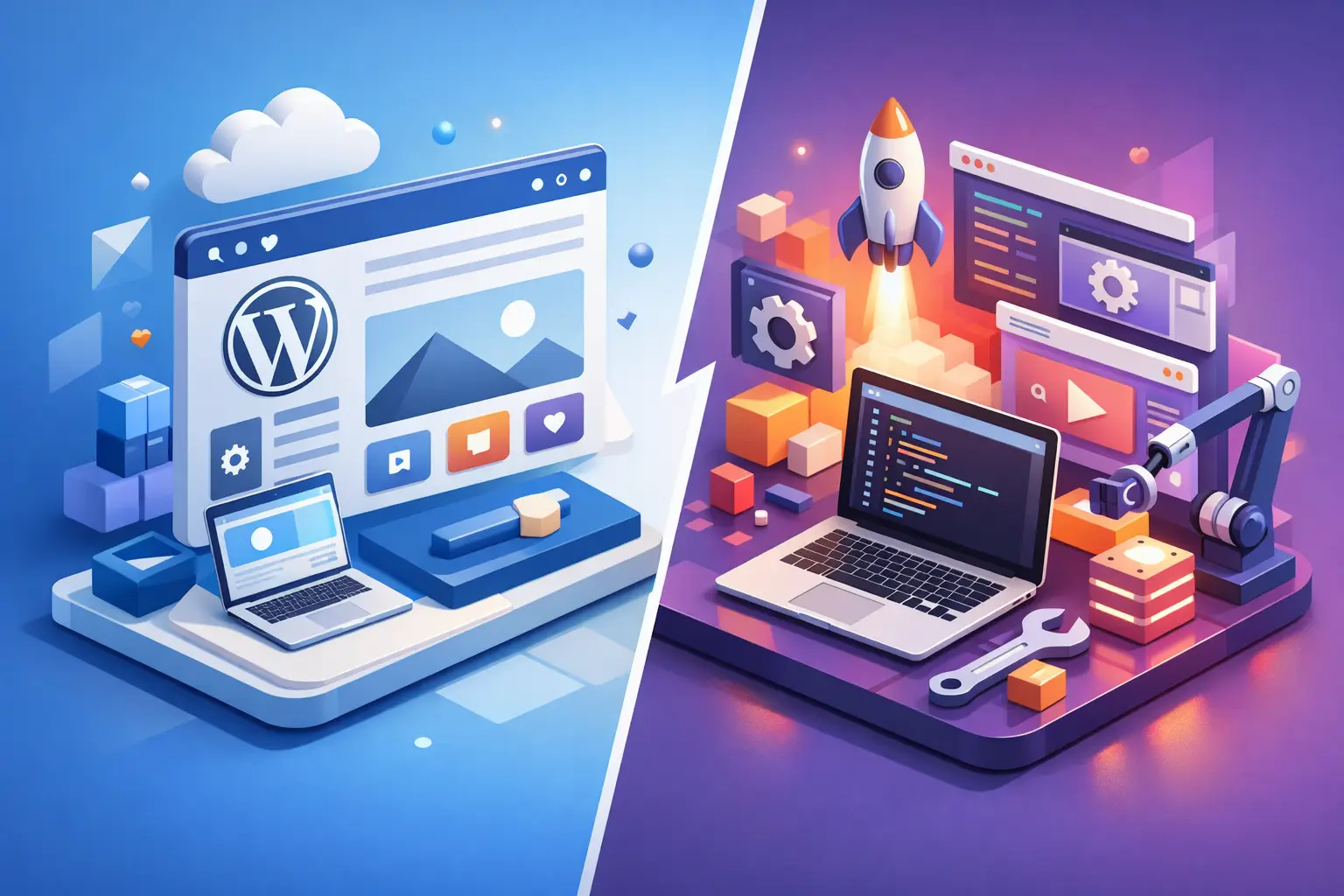
A business owner asks for a new website, and the first question is often the wrong one: “Should I use WordPress or do web development?” That framing creates confusion because the difference between WordPress and web development is not a simple either-or choice. One is a platform. The other is the broader process of building websites and web-based functionality.
If you are trying to grow visibility, generate leads, and turn your site into a sales asset, knowing how these two relate can save you time, money, and bad decisions.
What is the difference between WordPress and web development?
WordPress is a content management system, or CMS. It gives you a foundation for building and managing a website without creating every feature from scratch. You can use themes, plugins, page builders, and custom code to launch anything from a basic service site to a large ecommerce store.
Web development is the full discipline of creating websites and web applications. It includes front-end design implementation, back-end programming, database work, integrations, custom functionality, performance optimization, and security configuration. WordPress development sits inside web development as one category.
So the clearest way to understand the difference between WordPress and web development is this: WordPress is one tool or ecosystem within the much larger field of web development.
That matters because many businesses compare them as if they are competing products. They are not. A WordPress site can involve serious web development, and a custom-built web platform may use no WordPress at all.
WordPress is a platform. Web development is the craft.
Think about it from a business angle. If you need a professional website for your company, WordPress can often get you to market faster. It is popular because it supports content management, design flexibility, SEO tools, and ongoing updates without requiring a fully custom build every time you want to change text or publish a page.
Web development is the work behind the scenes that makes websites function the way a business needs them to function. Sometimes that means building on WordPress. Other times it means creating a custom application with a different tech stack because the project needs advanced workflows, unique dashboards, or specialized integrations.
This is where many business owners get tripped up. They hear “WordPress” and think cheap template website. They hear “web development” and think expensive custom coding. In reality, both can range from simple to sophisticated depending on the goals.
When WordPress makes strong business sense
For many small to mid-sized businesses, WordPress is the practical choice. It is especially effective when your site needs to support lead generation, local SEO, service pages, blog content, landing pages, and manageable updates by your team.
A well-built WordPress site can absolutely look custom, perform well, and support real business growth. It is not limited to hobby blogs. With the right setup, it can power polished service websites, online stores, booking systems, membership content, and multi-location businesses.
The biggest advantage is efficiency. You are not paying to reinvent common website functions that already exist in a mature ecosystem. That usually means faster timelines and lower development costs, which is a smart move for brands that want to invest not just in the site itself, but also in SEO, content, and marketing.
WordPress also gives businesses more control over day-to-day content. If your team needs to update photos, publish blog posts, add service pages, or refresh offers, that process is usually much easier than relying on a developer for every change.
When custom web development is the better move
There are times when WordPress is not the best fit. If your business needs a highly specialized platform, custom software behavior, advanced user roles, unusual integrations, or application-level functionality, a fully custom web development approach may be the stronger long-term investment.
For example, a business that needs a proprietary quoting engine, a custom client portal, or complex inventory logic across multiple systems may outgrow what is practical in WordPress. Yes, developers can stretch WordPress far, but pushing any platform too far can create maintenance issues, plugin conflicts, or performance bottlenecks.
Custom web development gives you more control over architecture and functionality. That can improve scalability for the right project. The trade-off is that custom builds usually require a bigger budget, more planning, and a stronger technical support structure over time.
That is why the right answer depends on the business model, not just the website wish list.
Difference between WordPress and web development in cost and speed
Cost is one of the biggest decision factors, and this is where the conversation should be honest.
WordPress is often more affordable because it uses an established system with reusable components. You can launch faster, manage content more easily, and avoid paying for custom coding where it is not needed. For service businesses, local brands, and growing companies, that can be a major advantage because speed to market matters.
Custom web development usually costs more because you are paying for architecture, coding, testing, and often more detailed project scoping. It also takes longer. That does not make it a bad choice. It simply means the return has to justify the investment.
If your revenue model depends on unique functionality, custom development may produce a stronger payoff. If your priority is lead generation, search visibility, and a site your team can actually use, WordPress may deliver better value faster.
SEO, performance, and flexibility
Some business owners assume custom-built websites automatically rank better. That is not true.
SEO performance depends far more on strategy and execution than on whether a site uses WordPress. Site structure, page speed, technical setup, content quality, on-page optimization, internal linking, and local relevance all matter more than platform choice alone.
WordPress can be excellent for SEO when it is properly built. It supports clean content structures, metadata management, image optimization, schema support, and blogging at scale. Problems usually come from poor development decisions, bloated themes, too many plugins, or weak hosting, not from WordPress itself.
Custom web development can provide tighter control over performance and code efficiency, but only if the project is scoped and executed well. A custom site can still underperform if SEO is treated as an afterthought.
This is why businesses looking for growth should not ask only what platform they want. They should ask what kind of visibility, user experience, and conversion path they need.
The real question: what are you trying to build?
If your goal is to create a marketing website that attracts traffic, explains your services, supports content strategy, and converts visitors into calls or form submissions, WordPress is often the smart answer.
If your goal is to build a more complex digital product with custom logic and functionality that goes beyond a standard marketing site, web development outside the WordPress ecosystem may be the right route.
There is also a middle ground that many businesses overlook. You can build a highly customized website on WordPress with professional web development behind it. That gives you a balance of efficiency, flexibility, and business control.
For many companies, that middle ground is where the best results happen. You get a site tailored to your brand, built for search visibility and conversions, without taking on the full cost of a ground-up application build.
How to choose without wasting budget
The best decision starts with business objectives, not platform bias. If you are comparing options, look at who will manage the content, how much customization you actually need, what integrations matter, how important SEO is to your acquisition strategy, and how quickly you need results.
A simple brochure site does not need enterprise-level custom development. On the other hand, a business with layered functionality should not force everything into a template-driven setup just to save money upfront.
That is where strategy matters. A good agency or development partner should help you separate must-haves from nice-to-haves, then recommend the approach that supports revenue, visibility, and long-term growth. At Ramikar, that is exactly how we look at website decisions – as part of a larger system that includes branding, SEO, content, and conversion performance.
WordPress and web development are not enemies. One is often the vehicle, and the other is the expertise that makes the vehicle perform.
If you are choosing between them, stop asking which one sounds more advanced and start asking which one gives your business the clearest path to stronger visibility, better user experience, and more qualified leads. That is where smart growth starts.