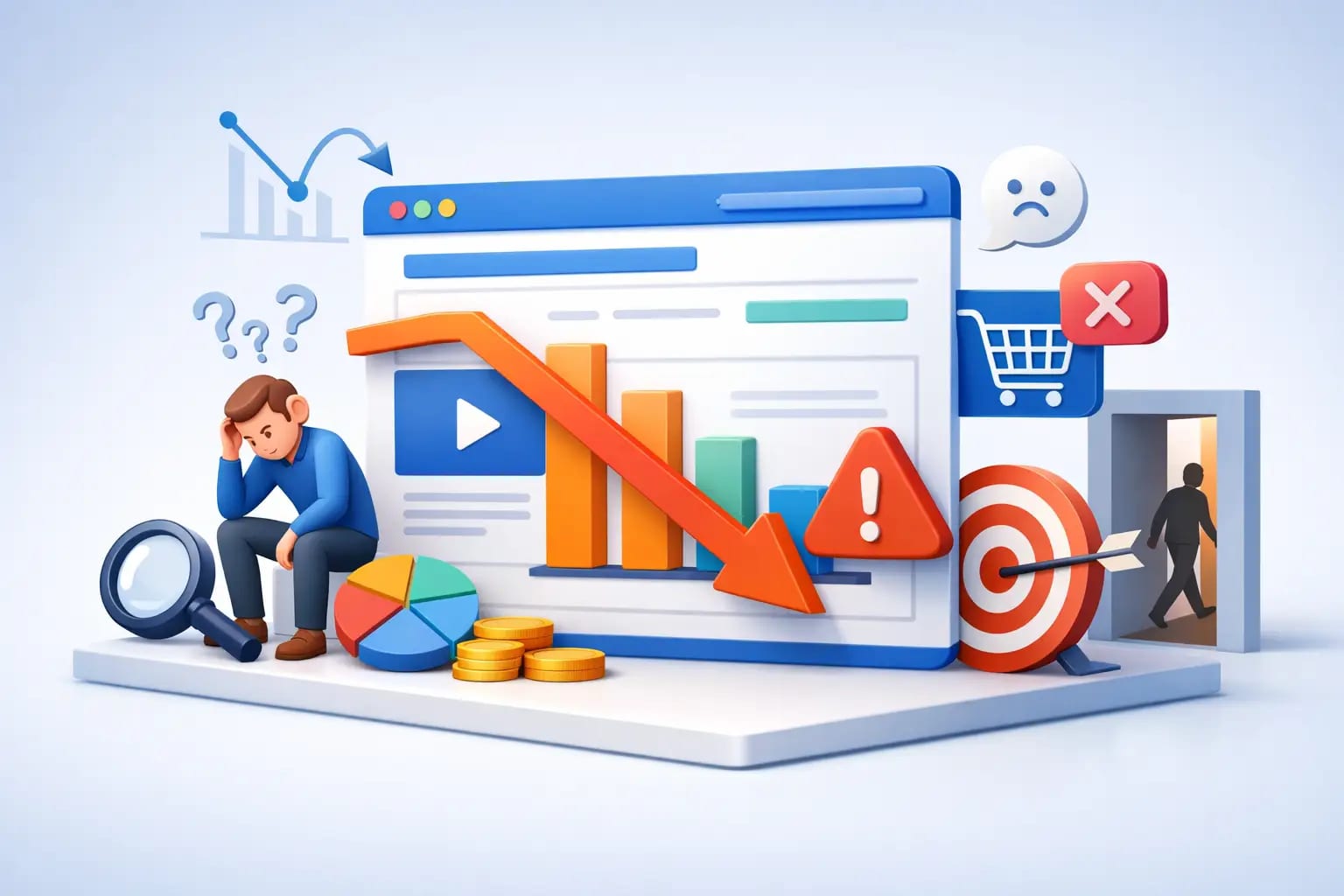
You paid for the website, launched it, maybe even drove traffic to it – and still the leads are weak, the sales are inconsistent, or the contact form stays quiet. If you keep asking, “why is my website not converting,” the problem is rarely just one thing. Most underperforming websites are losing business through a mix of unclear messaging, weak trust signals, poor user flow, and traffic that was never a good fit in the first place.
A website should do more than look polished. It should move visitors toward action. That might mean a call, a booked consultation, a form submission, or a purchase. If that action is not happening often enough, your site is not working as a growth asset. It is acting more like a digital brochure.
Why is my website not converting even with traffic?
Traffic can create the illusion that everything is fine. Business owners see visitors coming in and assume conversions should follow naturally. They do not. More traffic only helps when the right people land on the right page and immediately understand what to do next.
A common problem is mismatch. Your ads, SEO, social media, or referrals may be bringing people in, but the landing page does not match their intent. Someone looking for emergency plumbing should not have to sift through a vague homepage about quality service. Someone shopping for a product should not have to hunt for pricing, shipping details, or reviews.
This is where many websites fall short. They focus on being informative or visually impressive, but they do not guide decisions. A converting website reduces friction. It answers the next question before the visitor has to ask it.
Your message may be too vague
One of the fastest ways to lose a potential customer is to make them work to understand your offer. If your headline says something broad like “innovative solutions” or “we help businesses grow,” it sounds fine but says almost nothing. Visitors need clarity within seconds.
Strong conversion messaging is specific. It tells people what you do, who it is for, and why they should care right now. A contractor, law firm, med spa, ecommerce brand, or local retailer all need different language because their buyers make decisions differently. What works for one business can hurt another.
When messaging is too general, visitors do not feel seen. They leave because the site feels like it could be for anyone. In practice, that means it converts no one particularly well.
Design is not the same as conversion
A modern site can still underperform. Clean layouts, bold visuals, and polished branding matter, but design alone does not close the gap between interest and action.
Sometimes the issue is that the design prioritizes style over usability. Text may be too light to read. Buttons may blend into the background. Important offers may sit too far down the page. On mobile, sections may feel endless, cluttered, or awkward to navigate.
Good design supports decision-making. It highlights key actions, creates visual hierarchy, and removes distractions. If every section screams for attention, nothing stands out. If every page has a different structure or tone, trust drops. Consistency matters because visitors notice friction even when they cannot explain it.
The conversion path is probably too complicated
Many websites ask for too much too soon. A visitor clicks through, gets interested, then runs into a long form, confusing navigation, too many choices, or unclear next steps. That is where momentum dies.
The best-performing websites make the path forward obvious. If your goal is lead generation, your calls to action should be visible, relevant, and easy to follow. If your goal is ecommerce, product pages should reduce hesitation with clean descriptions, clear pricing, shipping details, and social proof.
There is always a balance. Asking for less in a form may increase lead volume but lower lead quality. Asking for more may improve sales readiness but reduce submissions. The right setup depends on your sales process, margins, and customer behavior.
Why is my website not converting on mobile?
For many businesses, mobile is now the primary experience, not the secondary one. If your site looks decent on desktop but feels frustrating on a phone, you are likely losing a large share of potential conversions.
Mobile conversion problems often show up in simple ways. Buttons are hard to tap. Text is cramped. Popups block the screen. Contact forms are tedious. Load times feel slow on cellular data. Maps, phone numbers, and booking tools are harder to use than they should be.
This matters even more for local service businesses. A person searching from a phone often has immediate intent. They may be comparing providers in Vancouver, Burnaby, Surrey, or Richmond while ready to call today. If your mobile experience creates delay or confusion, that lead goes elsewhere.
Trust signals might be missing
People rarely convert on confidence alone. They look for proof. If your website does not reassure visitors that your business is credible, established, and worth contacting, even interested users may hesitate.
Trust can come from reviews, testimonials, case results, before-and-after visuals, recognizable clients, certifications, guarantees, transparent policies, and real photos of your team or work. It also comes from subtler details such as professional branding, accurate copy, and a site that feels current.
A dated website creates doubt, even if your business is excellent. So does stock-heavy imagery, generic claims, or missing business information. Visitors are constantly evaluating risk. Your job is to lower it.
Your offer may not be strong enough
Sometimes the website is not the core issue. Sometimes the offer itself is weak, unclear, or too similar to what everyone else is saying. If your value proposition is just “great service” or “competitive pricing,” that is not much of a reason to choose you.
A strong offer gives the customer a clear benefit and a reason to act. That could be speed, specialization, convenience, availability, bundled value, financing, free consultation, custom strategy, or a smoother experience. The details depend on the market.
This is where strategy and creative execution need to work together. The words on the page, the structure of the service, and the visual presentation all shape perceived value. Ramikar approaches this as a connected system because conversion improves when the brand, website, and marketing message reinforce each other instead of competing for attention.
You may be attracting the wrong audience
Not all traffic is good traffic. A site can struggle because the visitors arriving were never likely to convert. That happens when SEO targets broad terms without clear intent, ads bring in curiosity clicks, or social content reaches people outside your buying audience.
This is why conversion rate should never be judged in isolation. A low rate could mean the site needs work. It could also mean your acquisition strategy is off. If the wrong users keep landing on the site, even a well-built experience will underperform.
The real question is not just how many visitors you get. It is whether they match your service area, budget level, urgency, and buying stage.
Technical issues quietly kill conversions
Some websites lose business through problems that owners do not notice right away. Slow page speed, broken forms, poor indexing, inconsistent tracking, layout shifts, and checkout errors can all damage performance.
These issues are especially expensive because they often go undetected. If form submissions fail or analytics are misconfigured, you may think demand is low when the system itself is broken. Technical SEO and site performance do not just help visibility. They protect revenue.
This is also where trade-offs come into play. Adding animations, plugins, and visual features may make a site feel richer, but too many can hurt speed and usability. Growth-focused websites are not built around features for their own sake. They are built around what helps users take action.
What to fix first if your website is not converting
Start with the pages that matter most. Usually that means your homepage, top service pages, key landing pages, product pages, and contact flow. Look at each one through a simple lens: Is the offer clear? Is the next step obvious? Is there enough trust to act? Is anything making this harder than it needs to be?
Then check your traffic sources. If users from search, ads, and social behave very differently, that tells you a lot. High bounce rates, weak engagement, or abandoned forms often point to mismatched intent or friction in the journey.
After that, review mobile experience, page speed, calls to action, and trust signals. Most conversion problems become easier to fix once you stop treating the website as one big issue and start looking at it as a series of decision points.
A website does not need more noise. It needs sharper positioning, stronger structure, and a clearer path to action. When those pieces align, conversions stop feeling unpredictable and start becoming measurable. That is when your website begins to do what it was supposed to do all along – help your business grow.