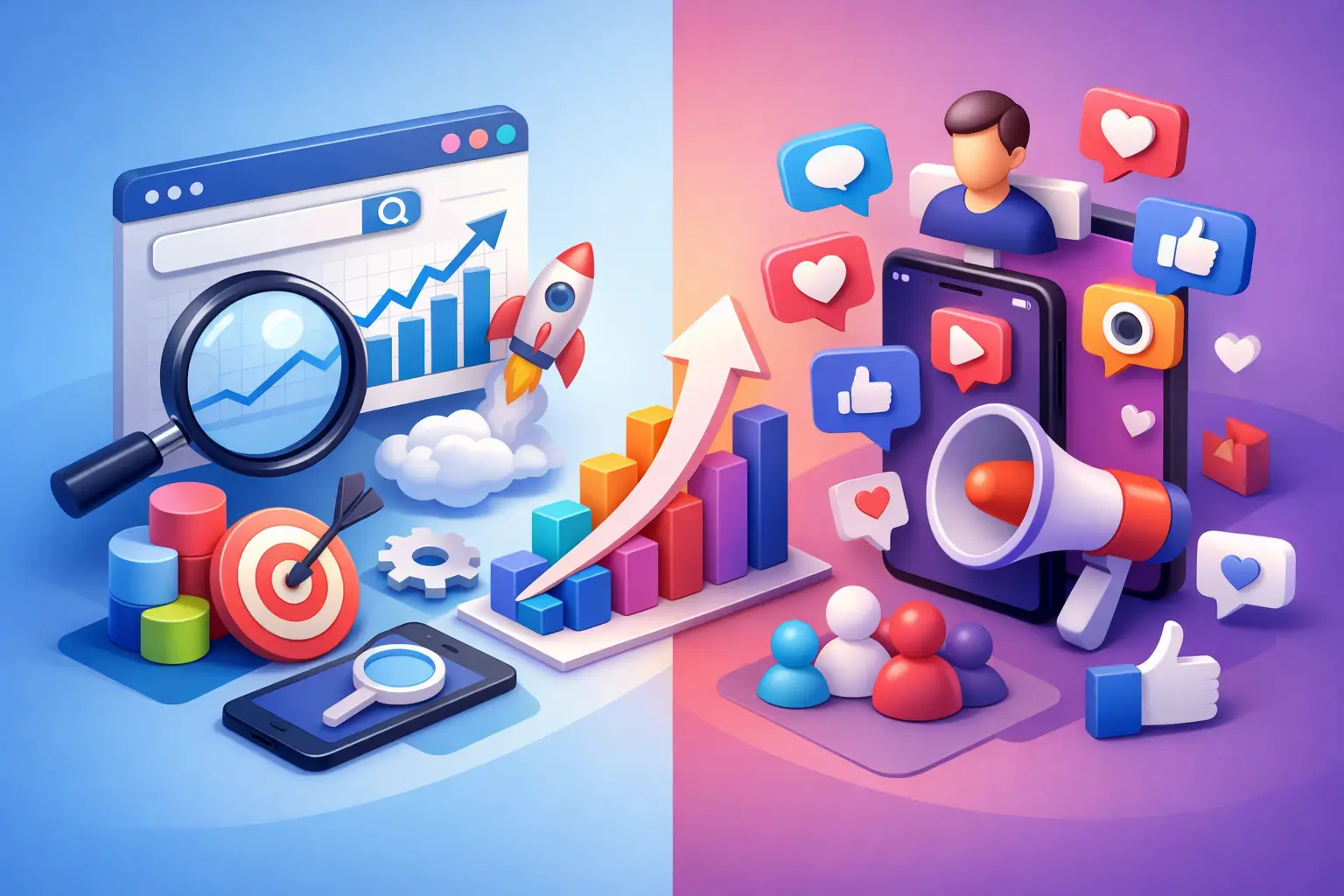
One channel brings intent. The other creates attention. That is the real tension in seo vs social media, and it is why so many business owners put money into marketing without getting the return they expected. If your website is not showing up when buyers search, you lose demand that already exists. If your brand is invisible on social platforms, you miss the chance to shape demand before people are ready to buy.
For most growing businesses, this is not a branding question. It is a revenue question. Where should you invest first, and which channel will actually move leads, calls, bookings, and sales?
SEO vs Social Media: The Core Difference
SEO helps your business appear when people are actively looking for a product, service, or solution. Social media helps your business get seen by people who may not be searching yet but can still become interested, engaged, and eventually ready to buy.
That difference matters because buyer intent changes everything. A person searching for “emergency plumber near me” is far closer to a purchase than someone casually scrolling Instagram or Facebook. Search traffic often converts better because it starts with a need. Social media often scales awareness faster because it starts with exposure.
Neither channel is weak. They just do different jobs.
SEO is usually the stronger long-term play for businesses that want steady visibility, qualified traffic, and lower acquisition costs over time. Social media is usually the faster play for businesses that want immediate reach, audience interaction, and frequent brand exposure.
When SEO Is the Better Investment
If your business depends on people finding you at the exact moment they need you, SEO should carry serious weight in your strategy. This is especially true for local services, home services, legal, medical, professional services, and ecommerce categories with clear search demand.
Search brings in users with purpose. They are looking for answers, comparing providers, or trying to make a decision now. That makes SEO especially effective for capturing bottom-of-funnel traffic.
A well-optimized website can keep producing leads long after the initial work is done. That does not mean SEO is automatic or easy. It takes time, technical precision, content alignment, and consistency. But once rankings improve, your site can become a dependable acquisition asset instead of a brochure that sits online doing very little.
SEO is often the better first investment when your website is underperforming, your Google visibility is weak, and your business relies on discovery through search. It is also critical when local competitors are taking the map results and organic clicks that should be yours.
What SEO Does Best
SEO excels at capturing high-intent traffic, improving local discoverability, supporting long-term lead generation, and increasing trust through strong search presence. When your business shows up repeatedly in search results, it signals legitimacy. Buyers notice that.
It also strengthens every other marketing effort. If someone sees your brand on social media and then searches your company name, your website needs to show up clearly, load quickly, and guide them toward action. Without that foundation, social traffic often leaks away.
Where SEO Has Limits
SEO is not instant. If you need sales next week, SEO alone may not be enough. Competitive markets can take months to gain traction, and poor websites can delay results further. SEO also depends heavily on website quality. If your site is slow, confusing, outdated, or weak on conversion, better rankings will not solve the whole problem.
When Social Media Is the Better Investment
Social media is powerful when your business needs attention, familiarity, and ongoing customer touchpoints. It works especially well for visual brands, lifestyle products, restaurants, retail, events, personal brands, and businesses that benefit from showing personality, proof, and momentum.
Social platforms let you create demand rather than wait for it. You can show your work, highlight customer results, answer objections, promote offers, and stay visible in a crowded market. That visibility has value, especially when people are not ready to buy on day one.
For newer businesses, social media can also be one of the fastest ways to look active and credible. A polished website matters, but a dormant social presence can make a brand feel out of touch. On the other hand, an engaged social feed can reinforce trust and make your business feel current, responsive, and established.
What Social Media Does Best
Social media is excellent for awareness, audience building, repeat exposure, and brand personality. It gives businesses a way to stay top of mind between buying moments. It also creates room for content that would never rank in search but still helps people connect with your business.
That includes behind-the-scenes videos, testimonials, product demonstrations, before-and-after content, seasonal promotions, and educational short-form posts. In many industries, this kind of content helps buyers feel more confident before they ever fill out a form or make a call.
Where Social Media Has Limits
Attention on social media is rented, not owned. Algorithms shift, organic reach changes, and yesterday’s strong post can be forgotten by tomorrow. Social can drive engagement without driving conversions if the strategy is too broad or disconnected from actual business goals.
It also tends to attract lower-intent traffic than search. That does not make it less valuable, but it does mean the path to conversion is often longer. Social media can create interest quickly, yet it usually needs stronger follow-up systems to turn that interest into revenue.
SEO vs Social Media for Leads and Sales
If the goal is qualified inbound leads, SEO often wins. If the goal is reach, brand awareness, and audience growth, social media often wins. But businesses rarely grow on one metric alone.
A local roofing company, for example, may get stronger direct lead flow from SEO because homeowners search when they need repairs or estimates. A boutique clothing brand may see faster traction through social media because style, identity, and visual presentation influence the buying decision earlier.
This is why channel choice should match business model. If customers search with urgency, prioritize SEO. If customers buy based on inspiration, community, or repeated exposure, social media deserves a larger share of attention.
Still, the strongest growth usually comes from using both with clear roles.
Why SEO and Social Media Work Better Together
The smartest approach is rarely seo vs social media as an either-or battle. It is a coordinated system where each channel strengthens the other.
SEO gives your business a durable visibility engine. Social media gives your business a voice, a face, and a steady stream of touchpoints. Search captures demand. Social shapes perception. Search converts active interest. Social keeps you in the conversation.
Here is what that looks like in practice. A prospect sees your business on Instagram, then searches your company name later. Strong SEO ensures they find the right pages quickly. Or someone finds your site through Google, does not convert, and later follows your brand on social. Social media keeps your business familiar until they are ready to act.
That combination often outperforms either channel on its own.
For businesses across competitive service markets, this matters even more. A polished website, strong local SEO, consistent branding, and active social content do not operate as separate tactics. They create one market presence. That integrated approach is where agencies like Ramikar help businesses move from scattered activity to measurable growth.
How to Decide Where to Start
Start with your current bottleneck, not with trends.
If nobody can find you on Google, your website traffic is weak, and local competitors dominate search results, SEO should come first. If your business looks invisible online, your brand lacks social proof, or you need more top-of-funnel attention, social media may be the faster first move.
You should also look at your assets. If you already have a strong website but little audience engagement, social media can amplify what is already in place. If you are posting regularly but your site barely ranks and does not convert, SEO and website performance need attention first.
Budget matters too. SEO often has a slower ramp but stronger compounding returns. Social media can create momentum faster, but it usually requires continuous content production and active management to maintain results.
The right question is not which one is better in general. It is which one solves your most expensive growth problem right now.
The Better Answer for Most Businesses
Most businesses do not need to choose one forever. They need to choose one to lead and one to support.
For service businesses, SEO often leads because demand already exists and search converts well. Social media supports trust, visibility, and retargeting. For product-driven and visual brands, social may lead because attention and brand identity drive discovery. SEO then supports product searches, branded traffic, and long-term website growth.
The businesses that pull ahead are not the ones posting everywhere or chasing every ranking opportunity. They are the ones building a digital presence that matches how real customers discover, evaluate, and choose.
If your marketing feels fragmented, that is usually the issue. Not a lack of channels, but a lack of alignment.
The strongest move is to build a system where your website, SEO, content, and social presence all point toward the same outcome: more visibility, better positioning, and more conversions from the audience that matters most. That is where marketing stops being noisy and starts becoming a real competitive edge.