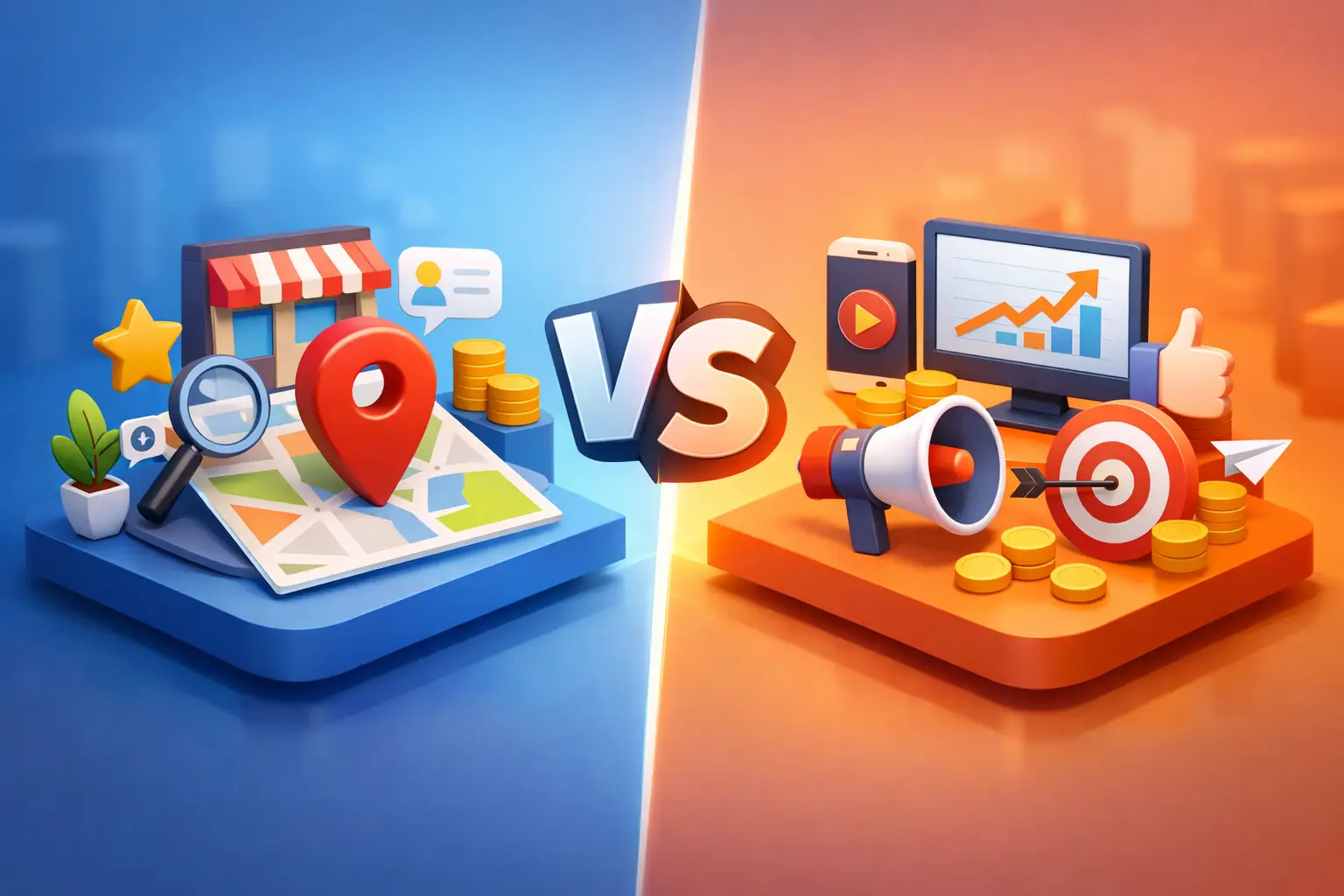
A business owner searches for more leads, sees competitors at the top of Google, and asks the same question almost every growth-minded company asks sooner or later: local SEO vs Google Ads – which one actually brings better results? The honest answer is not about picking a universal winner. It is about choosing the channel that fits your timing, budget, sales cycle, and competitive landscape.
For some businesses, Google Ads creates fast visibility and lead flow within days. For others, local SEO builds a stronger, more cost-efficient presence that keeps producing long after the initial work is done. The strongest growth strategy often comes from knowing what each channel does best and where each one falls short.
Local SEO vs Google Ads: the core difference
Local SEO is about earning visibility in organic local search results, Google Business Profile results, map results, and location-based searches. It helps your business appear when nearby customers search for services you offer. That visibility is built through website optimization, local content, reviews, citations, technical health, and a well-optimized business profile.
Google Ads is paid placement. You bid to show up in sponsored results for relevant searches, and in most cases, you pay when someone clicks. It gives you immediate access to search visibility, but that visibility is directly tied to budget, targeting, and campaign quality.
The simplest way to think about it is this: local SEO builds an asset, while Google Ads rents attention. Neither is wrong. They just solve different business problems.
When Google Ads is the better move
If your business needs leads now, Google Ads usually gets to work faster. A new campaign can put you in front of high-intent searchers almost immediately. That matters if you are launching a new service, entering a competitive market, or trying to fill your pipeline without waiting months for rankings to improve.
This speed makes Ads especially useful for service businesses with urgent customer demand. Think emergency plumbing, locksmith services, legal help, restoration, or urgent home repairs. In those markets, customers are not researching for weeks. They are searching, clicking, and calling.
Google Ads also gives you sharper control. You can target by geography, keyword intent, device, schedule, and even landing page experience. If you want to push one service in one city for one season, Ads can do that with precision.
The trade-off is obvious. Once you stop paying, the traffic stops. And in competitive industries, cost per click can rise quickly. A poorly built campaign can burn budget on low-intent searches, weak landing pages, or broad targeting that looks busy in reports but does not turn into revenue.
When local SEO is the better investment
Local SEO is often the smarter long-term play for businesses that want sustainable visibility without depending entirely on ad spend. When your website, service pages, and Google Business Profile are properly optimized, you can earn recurring traffic from people actively searching in your market.
That matters because local search behavior is often highly commercial. Someone searching for a roofer, dentist, med spa, accountant, or web designer in their area is not browsing for entertainment. They usually have a real need and are close to taking action.
Local SEO also builds trust in a different way. Many users skip ads and go straight to map results, business profiles, and organic listings. Reviews, proximity, site quality, and brand credibility all shape that decision. If your business shows up consistently and looks established, you gain an advantage that paid ads alone cannot fully replicate.
The downside is timing. Local SEO rarely delivers overnight. It takes strategy, content alignment, on-page improvements, review growth, technical cleanup, and consistency. In competitive markets, it can take months before meaningful gains appear. For companies that need leads immediately, that delay can feel expensive.
Cost is not as simple as cheap vs expensive
A lot of businesses frame this decision around budget alone. That is understandable, but it often leads to the wrong choice.
Google Ads looks expensive because the cost is visible every day. You see the spend, the clicks, and the cost per lead. Local SEO can look more affordable because you are not paying per click, but the real investment happens upfront in strategy, content, optimization, and ongoing management.
The better question is not which costs less. It is which produces stronger returns for your business model.
If one closed lead is worth several thousand dollars, paid search may be highly profitable even with expensive clicks. If your margins are tighter or customer lifetime value is lower, local SEO may offer better economics over time because it lowers reliance on paid acquisition.
This is where many businesses get stuck. They compare channel cost without comparing customer value, close rate, and sales quality. A cheaper lead is not better if it never turns into business.
Lead quality depends on search intent and experience
Neither channel guarantees qualified leads on its own. The quality comes from the match between search intent, your message, and the next step you give the customer.
Google Ads can drive strong lead quality when keywords are tightly aligned with service intent and the landing page is built to convert. But if the ad is too broad or the landing page is generic, you may attract clicks from people who are curious rather than ready.
Local SEO often captures strong intent because users are already searching for a nearby provider. But rankings alone are not enough. If your website is outdated, your reviews are weak, or your business profile lacks credibility, the click may go elsewhere.
This is why performance rarely comes down to the channel in isolation. It comes down to execution. Strong creative, clear positioning, a fast site, persuasive service pages, and conversion-focused design raise the value of both SEO and Ads.
Local SEO vs Google Ads for different business stages
A newer business often benefits from Google Ads first. If you have little search visibility, few reviews, and a newer website, paid search can create early traction while your organic presence develops. It gives you a way to test service demand, refine your messaging, and start generating leads before SEO gains momentum.
An established business with a solid reputation may get more long-term value from local SEO. If people already know your brand, if you have reviews, and if your website has some authority, SEO improvements can compound faster and create a durable lead source.
For businesses in aggressive local markets such as Vancouver, Burnaby, Surrey, or Richmond, relying on just one channel can leave growth on the table. Competitors may dominate organic visibility while also buying paid placements. If your brand is absent from both, your market share shrinks in real time.
The best strategy is often both, but not equally
Businesses love the idea of doing everything at once, but smart growth is usually more focused than that. The right mix depends on your business goals.
If you need immediate lead volume, start heavier on Google Ads while building local SEO in the background. If you already have traffic and want to reduce acquisition costs over time, invest more aggressively in local SEO and use Ads selectively for high-value services, promotions, or coverage gaps.
This blended approach works because the channels strengthen each other. Ads gives you fast data on which services and keywords convert. SEO gives you long-term authority and lower-cost visibility. Together, they create better coverage across the search results page and reduce overreliance on a single source of leads.
That is where an integrated agency approach becomes valuable. When your website, local SEO, paid campaigns, and brand presentation work together, your marketing becomes more efficient. Ramikar helps businesses build that kind of connected growth system, where visibility is not just increased, but turned into measurable action.
How to choose the right channel for your business
If your pipeline is slow and you need leads in the short term, Google Ads is usually the practical first move. If your business wants stronger long-term search presence, lower dependence on ad spend, and better local credibility, local SEO deserves serious investment.
If your website is weak, your conversion rate is low, or your branding is inconsistent, fix that before expecting either channel to perform at its best. More traffic does not solve a trust problem. It only exposes it faster.
A strong decision usually comes down to three questions. How quickly do you need results? How competitive is your market? And how much are you willing to invest in building long-term visibility versus buying short-term attention?
The right answer is rarely ideological. It is commercial. Choose the strategy that meets your current growth objective, then build toward the one that strengthens your position six months from now. The businesses that win search are not always the ones spending the most. They are the ones investing with better timing, better execution, and a clearer plan.